EN
EN  NL
NL  DE
DE 
The right kitesurf board length depends on your height, weight and riding style. Longer boards (140-160cm) offer more stability for beginners, while shorter boards (130-140cm) give more maneuverability for advanced riders. Your board width also affects performance: wider boards (40-42cm) are more stable, narrower boards (38-40cm) are faster and more maneuverable. This guide answers all the questions about choosing the perfect kiteboard size.
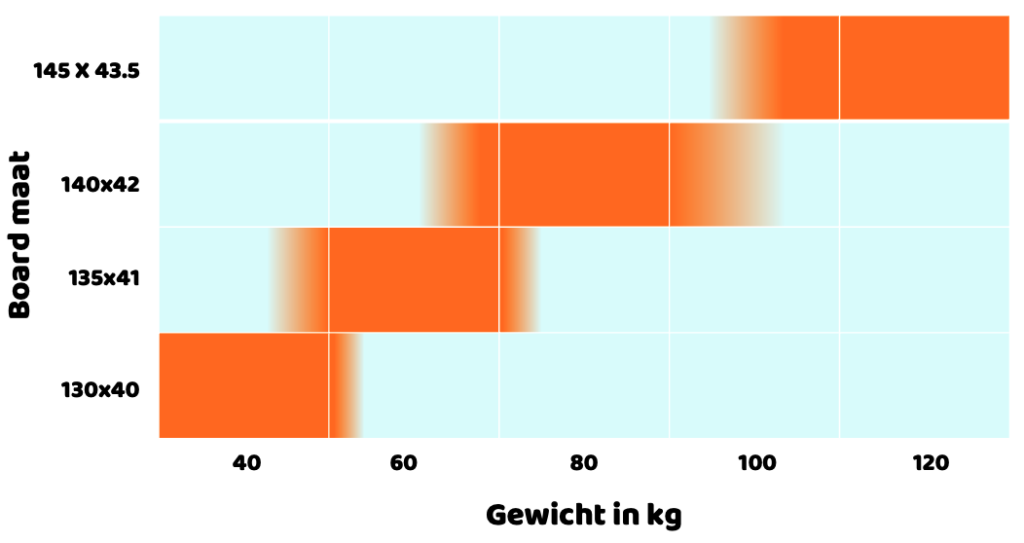
What determines the right kitesurf board length for my body?
Your height and weight together determine the ideal kiteboard size. Taller and heavier riders need more board surface area for adequate buoyancy and stability. In addition, your riding style plays a crucial role: beginners benefit from longer boards for extra stability, while experienced riders often prefer shorter boards for better maneuverability.
As a general guideline, riders between 60-75kg usually do well with 135-145cm boards. Heavier riders (75-90kg) tend to opt for 140-150cm boards, while lighter riders (under 60kg) are fine with 130-140cm boards.
Your experience significantly influences this choice. Beginners benefit from extra length for stability while learning, while advanced riders may choose shorter boards that are more responsive. Your riding style also plays a role: freeride riders prefer longer boards for comfort, freestyle riders choose shorter boards for tricks.
How does a short kitesurf board differ from a long kitesurf board?
Short boards (130-140cm) are more agile and responsive, making them ideal for tricks and quick direction changes. Long boards (145-160cm) offer more stability and comfort, especially in light wind conditions and for longer sessions. The difference in performance is noticeable in various aspects of kitesurfing.
Short boards have these advantages:
- Improved maneuverability for freestyle and tricks
- Faster edge-to-edge transitions
- Less resistance on jumps
- More compact and easier to transport
Long boards, on the other hand, offer:
- More stability in light winds
- Better comfort during long sessions
- Earlier planning in low winds
- More forgiveness for novice riders
They perform differently for different wind and water conditions. Long boards work better in light winds and choppy water, while short boards excel in strong winds and slippery conditions.
What board width best suits my weight and riding style?
The board width directly affects the stability and performance of your kiteboard. Wider boards (40-42cm) offer more buoyancy and stability for heavier riders, while narrower boards (38-40cm) are faster and more maneuverable for lighter riders and advanced techniques.
These guidelines apply to different driving styles:
Freeride kitesurfing: Choose wider boards (40-42cm) that offer comfort and stability during longer sessions. These boards plan earlier and are forgiving.
Freestyle kitesurfing: Smaller boards (38-40cm) give the maneuverability needed for tricks and rotations. They are lighter and more responsive for technical maneuvers.
Wave riding: Medium width (39-41cm) provides the balance between stability for waves and maneuverability for turns. The choice depends on wave conditions and your experience.
Your weight also determines the optimal width. Riders under 70kg usually do well with narrower boards, while heavier riders benefit more from wider boards for sufficient buoyancy.
What are the most common mistakes when choosing a kiteboard?
The biggest mistake is choosing too small a board to "learn faster," while beginners actually benefit from more stability. Other common mistakes include ignoring your riding style, underestimating progression needs, and focusing only on price rather than suitability for your level.
These errors are the most common:
- Wrong size estimation: Boards too small make learning more difficult, boards too large hinder progression
- Driving style ignore: Buying a freestyle board while wanting to do freeride
- Looking only at length: Width and shape are as important as length
- Underestimate progression: Choosing a board that you outgrow quickly
- Condition-specific choices: No consideration of local wind and water conditions
Many beginners also make the mistake of buying an expensive board right away without knowing what style suits them. It is wiser to try out several boards first before making a final choice.
How do you know when it's time for another board size?
You are ready for another kiteboard size When your current board hinders your progression or no longer suits your riding style. Signs include: difficulty planning in light winds, lack of maneuverability for new tricks, or uncomfortable feel during sessions. Changing preferences and skills also require different board characteristics.
Progression indicators that warrant a board change:
- You master waterstart and first boards consistently
- You want to learn freestyle tricks but your board is too stable
- You ride mostly in strong winds but have a light wind board
- Your board feels too big or too small for your current weight
Changing conditions may also warrant a switch. If you go kitesurfing more often at different spots with different conditions, a more versatile board may come in handy. Physical changes such as weight gain or loss also affect the ideal board size.
For beginning kitesurfers who are still discovering what riding style suits them, trying out different boards is valuable. By testing different sizes and styles, you'll discover what suits you best without making a big investment right away. A flexible subscription allows you to try out different boards and switch as you progress. You can easily build your set with boards that fit your level and preferences. Do you have questions about which board is best for you? Feel free to Get in touch at for personal advice on the ideal kiteboard choice for your situation.